



Video explanation-https://www.loom.com/share/c660b766bc984bf6a79f984bd5198ca3?sid=875dbdee-4a8b-4202-a351-50c11bbda1af
Overview:
The proposed system uses a constellation of small satellites with capture nets to actively remove dangerous debris from Earth orbit. By regularly capturing and deorbiting debris, the growth of hazardous orbital junk can be curtailed.
Concept of Operations:
- A launch vehicle deploys debris-removal satellites into target orbits
- Onboard sensors and processors detect and track debris, planning orbital intercepts
- Satellites maneuver to match debris orbits using efficient Hohmann transfers
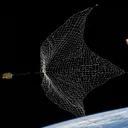
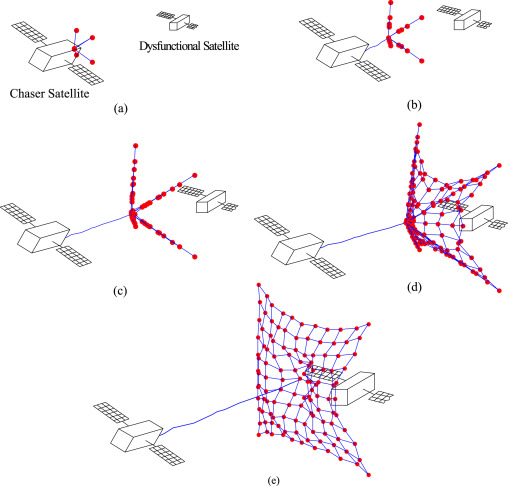
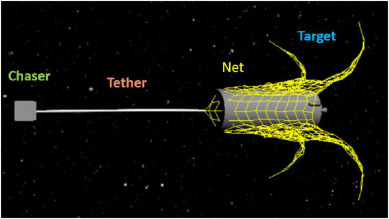
- At close range, a large Kevlar net unfurls to capture and enmesh target debris
- Kinetic impact is absorbed by net velocity dampers and flexible frame
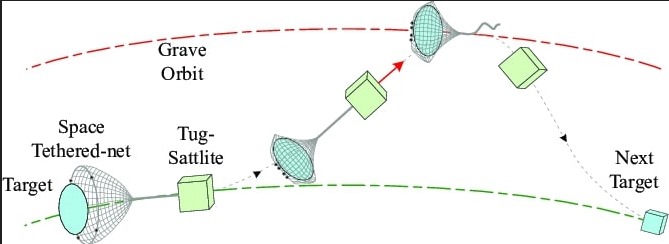
- With debris secured, satellite boosts to lower orbit where both burn up on re-entry
- New satellites launch to replace retired units, maintaining active removal capacity
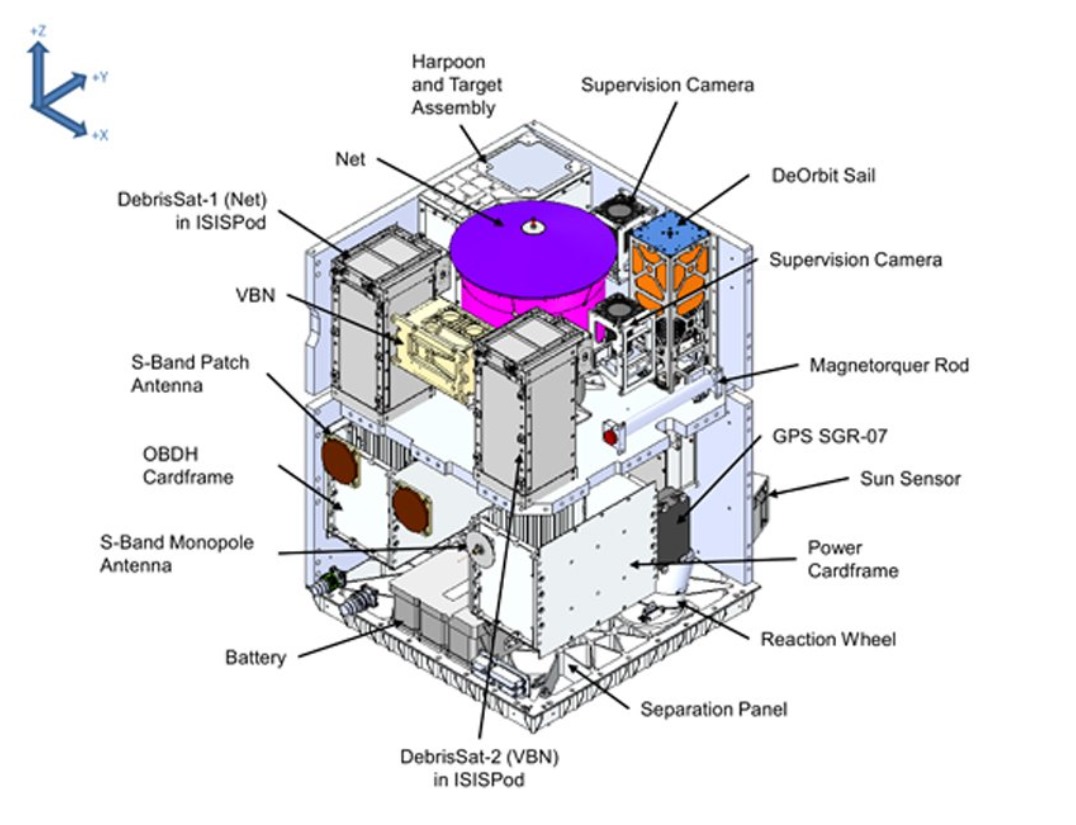
Satellite configuration:
Bus Structure:
- Main body: 1m x 1m x 2m rectangular prism frame constructed from aluminum alloy struts
- Mass of bus: 100 kg
- Attach points for modular payload components and propulsion tanks
Propulsion:
- 2 x iodine-fueled ion thrusters generating 0.5 N each
- 2 x iodine propellant tanks holding 100 kg total
- 8 x attitude control thrusters using hydrazine fuel and nitrogen tetroxide oxidizer
- Total delta-v > 100 m/s
Power:
- Deployable dual-junction GaAs/Ge solar arrays with 300W rated power per wing
- Total span of 20m when fully deployed
- Li-ion batteries with 300Wh capacity
- Power generation = 1000W at Beginning of Life
Avionics:
- Reaction wheels and momentum wheels for precise attitude control
- Star trackers and sun sensors for navigation updates
- S-band patch antenna for ground communication
- Redundant flight computers and data buses
Debris Capture System:
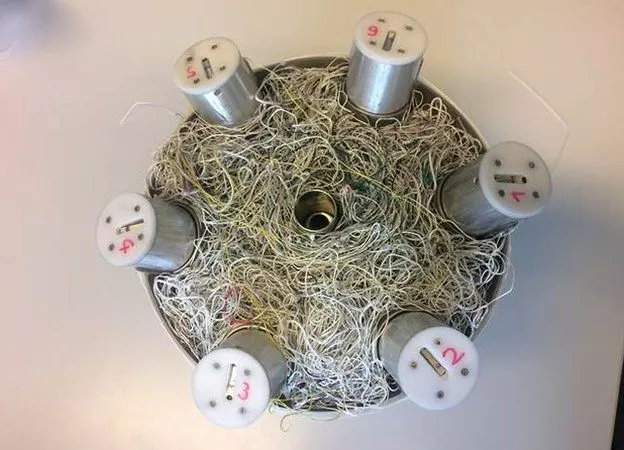
- 10m x 10m Kevlar net stowed on deployable boom
- Net booms extend 5m on each side
- Velocity dampers on net rim dissipate kinetic energy
- Nanotube tethers connect net to bus
Payload design:
Web design:
How it works:
Debris Population Modeling: The number of cataloged objects N can be modeled at time t by a quadratic equation accounting for fragments: N(t) = N0 + αt + βt^2
Where α represents debris generation rate and β is fragmentation coefficient. Taking the derivative yields debris growth rate:
dN/dt = α + 2βt
Integrating provides the total debris accumulated over mission timeframe T:
∫dN = ∫(α + 2βt)dt N(T) - N0 = αT + βT^2
Orbital Rendezvous: The relative motion of chaser and target is governed by the Clohessy-Wiltshire equations: x'' = 3n2x + 2ny' y'' = -2nx'
Where n is mean motion and x,y are relative positions. Solving the CW equations and nulling velocities at contact enables synchronizing orbits.
Debris Capture: The kinetic energy of debris target with mass m and velocity v is given by: KE = 1/2mv2
The energy absorbed by the net during capture is dissipated through net velocity damping or:
KE = 1/2kx2
Where k is net stiffness and x is net deflection. By balancing energy, the maximum velocity for capture can be estimated.
Deorbit Delta-V: The rocket equation can be integrated to find total delta-V available from propellant load mp: ΔVtotal = Ispg0ln(mi/mf) = Ispg0ln(mi/(mi-mp))
This allows calculating chaser propellant mass and refueling needs to achieve required deorbit burn velocities.